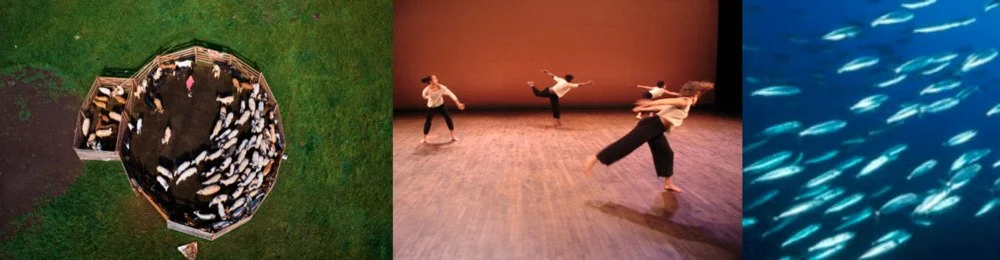
Emergent Improvisation
When you look up at the sky and see a migrating flock of geese,
When you are at the ocean and watch hundreds of pipers taking off from the beach,
When you watch a school of minnows under the surface of a lake,
When you watch a herd of deer crossing a landscape or a swarm of bees in your backyard,
You are witnessing a fundamental process of evolutionary design.
This act of self-organization, where there is no continuous leader, no predetermined script,
where ensembles create their own patterns.
Emergent Forms
Emergent Improvisation Defined
Practice + Performance
The practice and performance of emergent improvisation addresses the nature of improvisation in dance.
In the context of emergence, "improvisation" refers to the spontaneous creation of sound and movement by performers who are adapting to internal and external stimuli, impulses, and interactions without an outside director.
The phenomenon of emergence is found in a wide variety of natural settings. New kinds of order emerge, not because they are preconceived or designed, but as products of dynamic, self-organizing systems operating in open-ended environments. Evolution, for example, is now observed to be improvisational and emergent, as is the brain function that lies at the heart of what it is to be human.
Emergent improvisation explores the way in which natural processes underlie artistic expression along with the possibility that, in turn, art can help illuminate natural processes. In linking the creative work of art-making to the emergent process examined by science, there is a basis for a rich and textured inquiry into how systems come together, transform and reassemble to create powerful instruments of communication, meaning and exchange. While exploring concepts that underlie emergent phenomena, I developed artistic experiential experiments that aimed to amplify to extend our understanding of these issues.
Over the last nine years, in thinking about deep connections between ordering principles in nature and within dance and music improvisation, I’ve been asking: What kinds of forms might we look at that would inform both? What kind of experiments could be set up to find these principles? This investigation has resulted in three areas, research, education, and the practice and performance of Emergent Improvisation.
There are three key concepts that link Emergent Improvisation to the science of complex systems: self- organization, emergence, and complexity.
Self- organization is the ordering or structuring that arises within an ensemble of performers without a choreographer or director. The ordering comes from each individual interacting within an open ended environment.
Emergence is a potential outcome of self-organization and a property of a complex system. It is the phase in the process of interactions where the performers recognize a pattern arising that exposes the potential for something new–a collective behavior that is both different from and more than the sum of its parts.
Complexity is a structuring that arises at the edge of chaos, where there is enough order for an ensemble to recognize and sustain a pattern or system of patterns, yet enough openness to be adaptable to new aspects within the system, which can lead to the creation of a unique variation or new outcome. A complex system has a natural lifespan.
In addition to the elements of complex systems, I’ve observed the following factors that contribute to emergent improvisation.
Movement is the energy force driving all self-organizing systems in a directional flow in time. In the case of improvising dancers, movement is the basis of their vocabulary. This vocabulary of action includes gesture, emotional expression, rhythmic timing, and exploration of space.
The dancers are musicians in improvisation who have agency – the personal choice to move, create sound, and interact with the ensemble. Two essential aspects of agency are kinesthetic awareness (the sensation of being embodied) and a desire to interact by mimicking, exchanging, contrasting, and/or developing gestures, rhythms, and energy with others.
The self-organizing relationship of movement within a particular time and space, within a particular context or composition–in scientific terms, embeddedness– will create a variety of dynamic structures.
Memory is an essential factor and a complex system in itself. Structuring is an act of learning while building shapes and patterns. Learning involves memory–reconstructing a past experience into present thinking and action. This learning is essentially a selection process, choosing certain patterns over others in order to find more adaptable solutions. Dancers and musicians use their complex system of memory to build compositional structures.
In EI, three levels of interaction, what I call topologies, exist at once: the local neighbor interaction, the small group ensemble, and the global collective behavior. The